Egypt & Jordan 9 days
9 Days Egypt & Jordan Essentials
Cairo · Luxor · Aswan · Petra · Wadi Rum
Licensed guide
4★/5★ hotels
All transfers
Domestic flights

Cairo, a Nile cruise, Petra by day and Wadi Rum by starlight — Egypt and Jordan in one seamless 10-day trip, private-guided in both countries and connected by a single 90-minute flight.
Cairo, a Nile cruise, Petra by day and Wadi Rum by starlight — Egypt and Jordan in one seamless 10-day trip, private-guided in both countries and connected by a single 90-minute flight.
Egypt and Jordan share more history than most travelers realize before they visit both. The Nabataeans who carved Petra grew wealthy controlling the same incense and spice routes that Ptolemaic Egypt traded along; the same desert light that falls on Giza’s limestone falls, a short flight later, on Petra’s rose-colored sandstone. This itinerary is built for travelers who want that connection made explicit rather than left to guesswork — ten days with real time given to both civilizations, not a rushed sampler of either.
The routing is deliberately old-fashioned in its thoroughness: two nights on the Nile between Aswan and Luxor, taking in Kom Ombo, Edfu, Karnak and the Valley of the Kings at a proper unhurried pace, then a single short flight into Jordan for Amman, Jerash, a full day at Petra with the Monastery climb, a night in the Wadi Rum desert, and a closing afternoon floating in the Dead Sea. Nothing here is a photo-stop version of a monument — every site gets the time a specialist guide needs to actually explain it. If you want the fullest, most historically complete version of an Egypt-and-Jordan trip rather than the compressed one, this is the itinerary built for that.
Expand any day for the full plan. Day 1 opens by default.
Your journey into the deepest layers of Egyptian and Jordanian history begins the moment you touch down in Cairo, where a Vista representative meets you past customs for a private, air-conditioned transfer straight to your Nile-view hotel — no queues, no confusion, no navigating an unfamiliar city on jet-lagged legs. Cairo sprawls across both banks of the river as one of the oldest continuously inhabited urban centers on earth, and even the drive in offers a first, unhurried glimpse of a metropolis where minarets, colonial-era facades, and modern towers sit within sight of pyramids that predate them by four and a half thousand years.
The rest of the day is deliberately left open. This trip covers extraordinary ground over its ten days — three ancient civilizations, two countries, and sites that reward genuine attention rather than a rushed glance — so the first evening is built for recovery, not sightseeing. Settle into your room, take a slow walk if you're feeling energetic, or simply rest. If your flight lands with enough daylight to spare, a welcome dinner is arranged to properly begin the trip and orient you with your guide before the archaeological immersion starts in earnest tomorrow.
Nothing quite prepares you for standing at the base of the Great Pyramid of Khufu — 2.3 million limestone and granite blocks, some weighing upward of 80 tons, raised around 2560 BC to a precision that still puzzles engineers today. Your guide walks you through the competing theories of construction (ramps, levers, sledges over wetted sand) while you take in the sheer scale of the Giza plateau: Khufu's pyramid alongside those of his son Khafre and grandson Menkaure, forming a funerary complex that has dominated the desert horizon for over four and a half millennia. The Great Sphinx, carved from a single limestone outcrop with the body of a lion and, most scholars believe, the face of Khafre himself, sits just below — weathered by wind and sand but still unmistakably commanding after thousands of years of watching the sun rise over the Nile valley.
The afternoon shifts from monument to museum: the Grand Egyptian Museum, home to the complete Tutankhamun collection — more than 5,000 objects from his tomb, many displayed together for the first time since Howard Carter's 1922 excavation. Beyond the golden mask, you'll see the boy-king's chariots, alabaster vessels, and ceremonial furniture, alongside galleries tracing Egypt's pharaonic timeline from the Old Kingdom through the Ptolemaic period. It's a full, immersive day of context-building that gives real depth to everything you'll see further south. Evening is yours; a felucca dinner cruise on the Nile is a relaxed, optional way to close out the day.
An early transfer to Cairo airport puts you on a short domestic flight south to Aswan, Egypt's southernmost city and, in antiquity, the frontier where Egypt met Nubia. Aswan's granite quarries supplied the obelisks and colossal statues found throughout the pharaonic world — you'll notice the region's distinctive pink granite in monuments all along this itinerary. Board your Nile cruise ship on arrival; this vessel is your floating base for the next two nights as you sail north through Upper Egypt, retracing, in reverse, the route ancient cargo and funerary barges once traveled.
After lunch onboard, the afternoon is given to two sites that bookend two very different eras of engineering ambition. The Aswan High Dam, completed in 1970, reshaped the entire Nile valley and created Lake Nasser, one of the largest reservoirs on earth. Its construction also triggered one of the twentieth century's most remarkable rescue operations: the Temple of Philae, dedicated to the goddess Isis and among the last outposts of ancient Egyptian religion (still in active worship into the 6th century AD), was disassembled block by block and reassembled on higher ground at Agilkia Island under a UNESCO-led campaign. Wandering its colonnaded courts and hypostyle hall at sunset, with the temple reflected in the water around it, it's easy to understand why this site was worth saving.
Kom Ombo is unlike any other temple in Egypt: a rare double temple, built with perfect bilateral symmetry so that two gods could be worshipped side by side without either taking precedence. The southern half is dedicated to Sobek, the crocodile god associated with fertility and the Nile's power, and the northern half to Horus the Elder, the falcon-headed god of kingship — each with its own entrance, hypostyle hall, sanctuary, and priesthood, mirrored down the central axis. Ptolemaic-era reliefs here include a famous depiction of surgical instruments, and an adjacent museum houses mummified crocodiles once venerated in Sobek's honor. The ship docks close enough that morning light catches the temple's columns directly off the riverbank — one of the most photogenic approaches on the whole cruise.
The ship continues sailing north through the late morning and into lunch, giving you time to relax on deck and watch riverside village life scroll past — a texture of Egypt that's easy to miss when moving between monuments by road. By late afternoon you arrive at Edfu, home to the best-preserved temple in Egypt: the Temple of Horus, largely intact because it was buried under desert sand for centuries before its 19th-century excavation, which spared it much of the damage seen elsewhere. Built over nearly two centuries during the Ptolemaic period on the site of older New Kingdom shrines, its pylon, courtyard, and sanctuary preserve an extraordinarily complete picture of Egyptian temple architecture and ritual. You'll reach it the traditional way, by horse-drawn carriage from the dock — a fittingly unhurried arrival for a site built to be experienced slowly.
Your final morning on the Nile is spent on Luxor's West Bank, ancient Thebes, where the pharaohs of the New Kingdom chose to be buried away from the fertile floodplain in a hidden desert valley designed to deter tomb robbers. The Valley of the Kings holds over 60 known tombs cut deep into limestone cliffs, their walls covered in painted texts from the Book of the Dead and the Amduat meant to guide the pharaoh through the underworld — Tutankhamun's tomb, discovered here in 1922, is the most famous, though several other tombs rotate on view and reward equally close attention. From there you'll visit the mortuary temple of Hatshepsut, one of only a handful of female pharaohs to rule in her own right, whose terraced temple at Deir el-Bahari was designed to echo the cliffs behind it in a strikingly modern-looking composition for a structure built around 1470 BC. A stop at the Colossi of Memnon — two 18-meter seated statues of Amenhotep III, all that remains above ground of what was once Egypt's largest temple complex — closes out the morning.
Disembark by early afternoon and transfer to the airport for the connecting flights north: Luxor to Cairo, then onward to Amman, arriving in Jordan's capital by evening. It's a travel-heavy afternoon by design, moving you efficiently from one ancient world into another so tomorrow can start fresh in Jordan.
Amman is built across seven hills and layered with history most visitors never expect from a capital city: the Citadel crowns Jabal al-Qal'a with remains spanning the Bronze Age through the Islamic period, including the striking Umayyad Palace and a temple to Hercules whose surviving columns still dominate the skyline. Below, the 2nd-century Roman Theatre, cut into the hillside and seating roughly 6,000, remains remarkably intact — a reminder that Amman was once Philadelphia, a prosperous city of the Roman Decapolis. A walk through downtown's markets adds a contemporary layer to the morning before you head north.
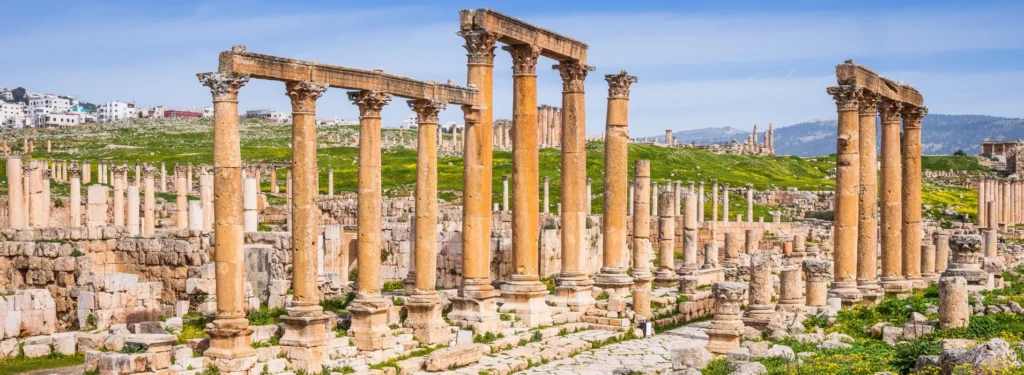
Jerash is, by most accounts, the best-preserved Roman provincial city outside Italy, and the scale of what survives is genuinely startling: an oval forum ringed by 56 Ionic columns, a mile of colonnaded cardo still scored with the ruts of ancient chariot wheels, two theatres, temples to Zeus and Artemis, and a monumental arch built to honor Hadrian's visit in 129 AD. Walking its main street, you're tracing the exact route Roman merchants and citizens once took through one of the Decapolis's wealthiest cities. From here, the itinerary turns south: a roughly three-hour drive along the King's Highway, an ancient trade route older than Rome itself, threading through Jordan's dramatic plateau country toward Wadi Musa. You'll check into your hotel and settle in over dinner, with Petra waiting just beyond the ridge for tomorrow.
Petra is the reason this itinerary exists, and today is built to give it the time it deserves. You enter on foot through the Siq, a natural sandstone gorge roughly 1.2 kilometers long where the rock walls rise up to 80 meters on either side, narrowing in places to just a few meters wide — carved by tectonic movement and water erosion over millions of years, then adapted by the Nabataeans with carved water channels still visible along its base. The approach is deliberately disorienting, the light dimming to a sliver overhead, until the gorge opens without warning onto the Treasury (Al-Khazneh): a 40-meter facade carved directly into rose-colored rock face around the 1st century BC, its Hellenistic-influenced columns and pediments a testament to how thoroughly this desert trading kingdom absorbed and reinterpreted Mediterranean architectural language.
From the Treasury, the site unfolds further than most visitors expect: the Street of Facades and Royal Tombs, four monumental tomb facades cut for Nabataean royalty, then the Roman Theatre — carved, unusually, directly out of the rock rather than built up from stone blocks, seating around 8,500 during Petra's height as a Roman provincial city after 106 AD. The colonnaded street beyond marks the city's Roman-era commercial spine. In the afternoon, those willing to make the climb — some 800 rock-cut steps — are rewarded at the top with the Monastery (Ad Deir), Petra's largest carved facade at nearly 50 meters wide, set against sweeping views toward Wadi Araba. For those who want to see the Treasury in an entirely different light, an optional evening return offers Petra by Night, the Siq and facade lit by roughly 1,800 candles in a hushed, wholly different atmosphere from the busy daytime crowds.
Little Petra, or Siq al-Barid ('the cold canyon'), sits about 8 kilometers north of the main site and functioned as a satellite trading suburb and caravanserai — a place where Nabataean merchants controlling the frankincense and spice routes could stage camel caravans before they entered the main city. Its scale is intimate compared to yesterday's monuments, but that's precisely the appeal: carved facades, cisterns, and even a small painted ceiling (one of the only surviving examples of Nabataean fresco) are all within a compact, walkable canyon that most visitors to Petra never reach, giving today a quieter, more exploratory rhythm.
From there, the landscape changes entirely on the roughly two-hour transfer south to Wadi Rum, a vast protected desert of red sand and towering sandstone and granite mountains that has drawn travelers, filmmakers, and Bedouin tribes for millennia. A 4WD jeep tour through the afternoon takes you past the Seven Pillars of Wisdom rock formation, Lawrence's Spring (linked to T.E. Lawrence's writings on the Arab Revolt), and petroglyphs and inscriptions left by Nabataean and Thamudic travelers thousands of years ago — some of the earliest evidence of writing in the region. As the sun drops, you'll climb a dune for sunset over the desert before settling into a Bedouin camp for the night, where dinner is often cooked the traditional way, underground in a sand oven, beneath a sky largely free of light pollution.
Morning in Wadi Rum moves at the pace of a camel, quite literally — a gentle ride through the desert lets the scale of this landscape sink in properly, the towering rock formations catching low morning light in shades of ochre and rose that the midday sun tends to flatten out. It's an unhurried, sensory close to the desert leg of the trip before the itinerary turns north again.
The transfer to the Dead Sea takes roughly four hours, again following the King's Highway through Jordan's central plateau, passing small villages and dramatic elevation changes as the road eventually descends toward the lowest point on the earth's land surface — some 430 meters below sea level. The Dead Sea's extreme salinity, roughly ten times that of ordinary seawater, is what makes floating here effortless and faintly surreal; the mineral-rich mud along its shores, prized since antiquity (reportedly by Cleopatra herself for its cosmetic properties), is yours to apply freely. The afternoon is unstructured and restorative by design: float, apply mud, rinse, repeat, or simply make use of your hotel's spa facilities after a physically full week of walking ancient sites and climbing carved staircases.
A final, unhurried morning at the Dead Sea closes out the trip — one more float in its mineral-heavy water, or a last spa treatment, before the practical business of heading home begins. There's no sightseeing pressure built into today; after nine days covering four and a half thousand years of pharaonic, Nabataean, and Roman history across two countries, this last morning is meant to be genuinely restful.
From your hotel, it's roughly an hour's transfer to Amman's Queen Alia International Airport for your departure flight, with timing coordinated around your specific itinerary. It's a quiet, low-key end to a trip that, over the preceding ten days, took you from the base of the Great Pyramid to the carved heart of Petra and the shores of the world's lowest sea.
Same itinerary — pick a tier to see its hotels, cruise and prices. Switch anytime; the trip stays identical.
| Room | LowMay – Sep | HighOct – Apr |
|---|---|---|
| Doubleper person, sharing | $2,860 | Peak$3,380 |
| Singleper person | $3,960 | Peak$4,670 |
Per person, in US dollars. Not valid during Christmas & New Year (peak-date supplement applies). Hotel names are representative examples in the 4-star tier — your exact properties are confirmed for your dates.
| Room | LowMay – Sep | HighOct – Apr |
|---|---|---|
| Doubleper person, sharing | $4,190 | Peak$4,950 |
| Singleper person | $5,770 | Peak$6,820 |
Per person, in US dollars. Not valid during Christmas & New Year (peak-date supplement applies). Hotel names are representative examples in the 5-star tier — your exact properties are confirmed for your dates.
The terms that matter — worth a read before you send an inquiry.
Cancellation charges depend on how far before your arrival date you cancel, as a percentage of the total package price.
Package terms differ from a cruise-only booking (hotels + cruise + internal flights). Once domestic flights are ticketed they are non-refundable regardless of the tiers above. Final terms are confirmed in writing before any deposit is taken.
Egypt first, then Jordan. Egypt is more logistics-intensive (Nile cruise, domestic flights), so we do it while your energy is highest, then wind down in Jordan.
Yes — Royal Jordanian and EgyptAir both operate multiple daily direct flights, 1 hour 45 minutes. No stopovers or overnights in transit.
Yes. Egypt: $25 e-visa (apply online 5-7 days before travel) or on arrival at Cairo airport. Jordan: free with the Jordan Pass (buy online before travel) or 40 JD (~$56) on arrival.
800 steps, moderate difficulty, ~45 minutes each way. Take water and pace yourself; you can also hire a donkey for the climb. Anyone reasonably mobile can do it.
Yes — modern Bedouin camps have proper beds with linens, en-suite bathrooms (in most), and dinner served under a tent. Very different from backpacker tents. Warm layers needed for evenings even in summer.
Tell us your dates and we'll confirm availability and a clear price.
Vista Egypt Tours uses Google Analytics to see which pages and trips are useful, so we can improve the site. You choose whether it may use cookies. Cookies Policy