8 Days Egypt & Dubai Highlights
Cairo's Pyramids and a Nile cruise, then Dubai's modern skyline, Abu Dhabi's Grand Mosque and a Bedouin desert safari — the classic Egypt & Dubai combination in 8 days.
The trip, in short
Cairo’s Pyramids and a Nile cruise, then Dubai’s modern skyline, Abu Dhabi’s Grand Mosque and a Bedouin desert safari — the classic Egypt & Dubai combination in 8 days.
Few pairings on earth create a sharper contrast than this one. Four and a half thousand years separate the Great Pyramid from the Burj Khalifa, and this trip puts them eight days apart on the same itinerary — stone raised by hand against glass raised by crane, a felucca sail against an abra ferry, a horse-drawn carriage at Edfu against a high-speed elevator to the world’s tallest observation deck. It’s a deliberately bold two-country combination for travelers who want maximum visual and cultural range without a long, complicated routing.
The structure keeps both halves properly full rather than treating one as a layover for the other: four nights in Egypt covering Giza, the Grand Egyptian Museum and a two-night Nile cruise from Aswan to Luxor, then a direct flight to three nights in the UAE covering Old and New Dubai, the Burj Khalifa at sunset, a full Abu Dhabi day at the Sheikh Zayed Grand Mosque and Louvre Abu Dhabi, and a closing desert safari with a Bedouin camp dinner. Eight days, two entirely different Egypts of ambition — the ancient and the ultra-modern — with a licensed local guide throughout both.
Why this trip stands out
Your itinerary
Expand any day for the full plan. Day 1 opens by default.
Touch down in Cairo and the contrast starts before you've even cleared the terminal — this is a city where satellite dishes crowd rooftops within sight of monuments older than recorded memory. Your Vista Egypt Tours representative meets you at arrivals for a fast, no-fuss handoff: passport formalities sorted, luggage collected, private air-conditioned vehicle waiting at the curb. No queues to navigate, no haggling with taxi drivers after a long-haul flight — just a smooth transfer through Cairo's sprawling, chaotic, unmistakably alive streets to your 5-star hotel.
Consider this evening a deliberate pause before the trip's first big reveal. Order something from the hotel restaurant, watch the city lights flicker on from your window, and let the jet lag settle. Tomorrow you're standing at the foot of the last surviving Ancient Wonder of the World — a structure that has outlasted empires, religions, and every skyline that has ever tried to compete with it. In eight days you'll be riding a glass elevator up the tallest building humans have ever built. Tonight, just rest. The whiplash begins at sunrise.
Nothing prepares you for the scale of the Giza Plateau in person. Photographs flatten it; standing at the base of the Great Pyramid of Khufu, you crane your neck and still can't see the top clearly — over four and a half thousand years old, built without a single piece of modern machinery, and still the largest pyramid on the planet. Alongside it rise Khafre's pyramid, retaining a cap of smooth original casing stone near its peak, and the smaller Menkaure, completing a trio that has anchored the desert horizon since before the wheel reached Egypt. The Sphinx crouches nearby, its lion's body and pharaoh's face worn by millennia of wind, still managing to look watchful. Time it right and you'll catch a camel silhouette crossing the dunes with the pyramids stacked behind it — the single most photographed frame in the country, and worth every second of the wait.
After lunch, swap open desert for a cathedral of glass and steel: the Grand Egyptian Museum, one of the largest archaeological museums built anywhere in the world this century. Inside waits the complete Tutankhamun collection — over 5,000 objects united under one roof for the first time since Howard Carter's team pulled them from the tomb, including the boy king's golden funerary mask displayed in a purpose-built gallery. It's a strange, thrilling loop: ancient treasure, ultra-modern museum architecture. A small preview of the bigger jump still to come.
A short domestic flight trades Cairo's urban sprawl for Aswan's quieter, sun-bleached calm — granite hills, feluccas drifting on turquoise water, Nubian villages painted in ochre and blue along the riverbank. This is Egypt's southernmost major city, historically the frontier between Egypt and Nubia, and it feels different the moment you step off the plane: slower, warmer, more intimate. Your cruise ship is waiting at the dock; check in, find your cabin, and settle in before lunch is served onboard as the crew casts off lines and the Nile begins its slow work outside your window.
The afternoon pairs two very different monuments to Egyptian ambition. First, the Aswan High Dam — a genuine feat of 20th-century engineering that tamed the Nile's ancient flood cycle and created Lake Nasser, one of the largest reservoirs on Earth. It's your first real taste of modern Egyptian infrastructure, a rehearsal in miniature for the megastructures waiting in Dubai. Then, by boat, out to Philae Temple, dedicated to the goddess Isis and relocated stone by stone in a 1960s UNESCO rescue operation to save it from the rising waters the dam itself created. Colonnaded courtyards, hieroglyph-carved walls, and river light bouncing off the water make this one of the most atmospheric temple visits in Egypt — a fitting first night's sleep to the gentle rock of the Nile.
Wake up moored at Kom Ombo, where a genuinely unusual temple awaits: a rare double sanctuary, split perfectly down its central axis and dedicated to two gods at once — the crocodile-headed Sobek and the falcon-headed Horus the Elder. Twin entrances, twin halls, twin sanctuaries running in parallel all the way to the back wall, an architectural oddity built to keep both deities equally honored under one roof. Nearby, a small museum houses mummified crocodiles pulled from the site, a reminder of just how seriously this cult was taken along this stretch of the river. Morning light on the sandstone here has a particular warmth that photographers chase.
Back onboard, the ship eases north with the current toward Edfu while you relax on deck, watching the Nile's daily rhythm scroll past — water buffalo at the shoreline, palm groves, children waving from small boats. Docking at Edfu, the transfer into town happens the old-fashioned way: by horse-drawn carriage, clattering through the streets in a burst of local color before arriving at the Temple of Horus. This is the best-preserved temple in all of Egypt, its pylon entrance and inner sanctuary shielded from flood damage for centuries by desert sand, meaning the carved reliefs and roofed halls survive in remarkable, almost startling detail. It's the clearest picture you'll get of what a fully intact Ancient Egyptian temple actually looked like.
Your last morning in Ancient Egypt is also its most concentrated. Cross to Luxor's West Bank — the realm of the dead in pharaonic belief — and descend into the Valley of the Kings, where tombs cut deep into the limestone hills once held Tutankhamun, Ramses the Great, and generations of New Kingdom royalty, their burial chambers still carrying painted ceilings and hieroglyphic texts meant to guide the dead through the underworld. From there, the terraced temple of Hatshepsut rises from the cliff face in dramatic, colonnaded tiers — built for Egypt's most powerful female pharaoh and still one of the most architecturally bold structures the ancient world produced. The two seated Colossi of Memnon, weathered and enormous, stand sentinel over the fields nearby, all that remains of a mortuary temple that once dwarfed them. Back across the river, Karnak Temple closes the loop: a vast complex of pylons, obelisks, and the famous hypostyle hall, its 134 giant columns once supporting a roof over what is still one of the largest religious structures ever built anywhere on the planet.
Then the pivot. Disembark, transfer to the airport, and fly Luxor to Cairo to Dubai, landing late in a city that has spent the last few decades building its own wonders — this time in steel, glass, and record-breaking height. You'll feel the shift the second you land: five thousand years of stone giving way, almost overnight, to twenty-first-century ambition.
Funny thing about Dubai — the morning starts in the part of the city that actually feels like a callback to Egypt. Deira's Gold Souk glitters with window after window of 22-karat jewelry, while the neighboring Spice Souk fills the air with cardamom, saffron, and frankincense, its narrow lanes and market chatter not far removed from the energy of Aswan's riverside stalls. You'll cross Dubai Creek the traditional way too, aboard a wooden abra ferry puttering between the docks — a slower, older Dubai that most visitors never bother to see before racing to the skyscrapers.
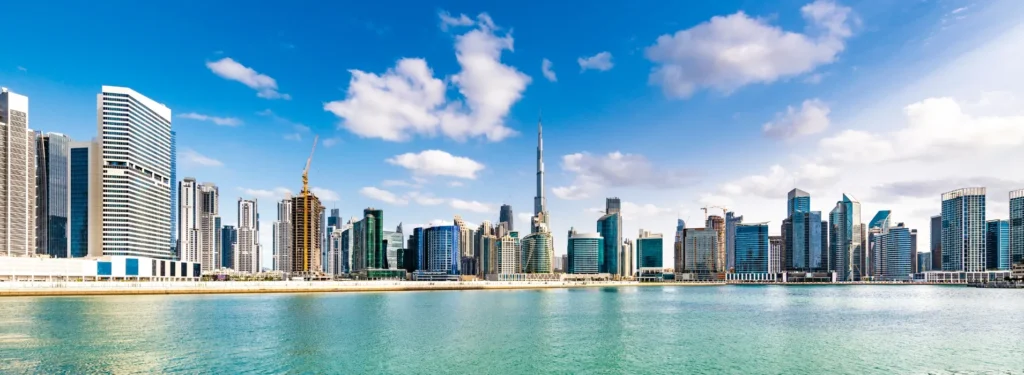
Then the afternoon detonates into the present day. The Dubai Mall is less a shopping center than a small city under one roof, home to an aquarium holding thousands of marine animals behind glass walls thick enough to double as an underwater viewing tunnel. Just outside, the Burj Khalifa waits — at 828 meters, the tallest building human beings have ever constructed, more than three times the height of the Great Pyramid you stood beneath just days ago. Ride the high-speed elevator to the "At The Top" observation deck timed for sunset, and watch Dubai's entire skyline ignite in gold and glass below you. As night falls, the Dubai Fountain performs its choreographed water show against the tower's base — jets soaring over 150 meters in time with music and light, a spectacle that would have been pure science fiction to the pharaohs whose tombs you walked through on this same trip.
A ninety-minute drive down the coast trades Dubai's glass towers for Abu Dhabi's more measured, monumental grandeur, and the day's first stop makes the case immediately: the Sheikh Zayed Grand Mosque. This is one of the largest mosques on Earth, its courtyard paved in a vast field of white marble inlaid with floral patterns, its walls and columns wrapped in gold-leaf calligraphy that catches the light from every angle. The main prayer hall houses one of the world's largest hand-knotted carpets and a chandelier collection dripping with Swarovski crystal — a building conceived not as a relic of the past but as a living, breathing statement of what devotion and modern construction can achieve together. Where Karnak's hypostyle hall used sandstone columns to awe worshippers three thousand years ago, this mosque does the same job in marble and crystal, built within living memory.
The afternoon shifts registers entirely at the Louvre Abu Dhabi, architect Jean Nouvel's outpost of the Paris institution, sheltered under a vast perforated dome that scatters light across the galleries like sunlight through palm fronds. Inside, artifacts spanning every civilization sit in deliberate dialogue with one another — including, fittingly, ancient Egyptian pieces standing just steps from contemporary art. It's the whole trip's premise distilled into a single museum floor. Return to Dubai as the sun sets, with one more full day of contrast still ahead.
One last landscape, and it's the desert again — though nothing like the one you left behind in Egypt. A 4WD convoy heads out into the dunes for an afternoon of dune bashing, the vehicle carving steep drops and crests across sand that shifts from gold to deep orange as the sun drops. Camel rides and sandboarding round out the adrenaline before the pace slows at a Bedouin-style camp: low seating, lantern light, and a barbecue dinner under a sky just starting to fill with stars, followed by live belly dance and a spinning tanoura performance. It's a fittingly theatrical send-off — the same desert that cradled Ancient Egypt's monuments now hosting the trip's final, purely modern spectacle.
From here it's a late-night transfer to Dubai International for your onward flight, closing out eight days that ran from the Great Pyramid to the world's tallest building, from horse-carriages in Edfu to abra ferries on Dubai Creek. Prefer not to rush the ending? Extend one more night and take a Day 9 morning flight instead — either way, you leave having seen both ends of human ambition, five thousand years apart.
Clear on price, clear on value
Included
- 2 nights hotel in Egypt (5-star) with daily breakfast
- 2 nights Nile cruise, full board
- 3 nights hotel in Dubai (5-star) with daily breakfast
- Domestic Egypt flights + Cairo → Dubai flight
- All transfers in private A/C vehicles
- Licensed local guide throughout Egypt and Dubai
- Desert safari with dune bashing + BBQ dinner
- All site entrance fees
Not included
- International flights to Cairo and from Dubai
- Egypt entry visa ($25); UAE entry is free for most Western passports
- Personal expenses, alcoholic drinks
- Tips
- Travel insurance
- Optional Petra by Night, other add-ons
Choose your hotel tier
Same itinerary — pick a tier to see its hotels, cruise and prices. Switch anytime; the trip stays identical.
| Room | LowMay – Sep | HighOct – Apr |
|---|---|---|
| Doubleper person, sharing | $2,520 | Peak$2,970 |
| Singleper person | $3,470 | Peak$4,110 |
Per person, in US dollars. Not valid during Christmas & New Year (peak-date supplement applies). Hotel names are representative examples in the 4-star tier — your exact properties are confirmed for your dates.
| Room | LowMay – Sep | HighOct – Apr |
|---|---|---|
| Doubleper person, sharing | $3,680 | Peak$4,350 |
| Singleper person | $5,080 | Peak$6,000 |
Per person, in US dollars. Not valid during Christmas & New Year (peak-date supplement applies). Hotel names are representative examples in the 5-star tier — your exact properties are confirmed for your dates.
Cancellation, price & children
The terms that matter — worth a read before you send an inquiry.
Cancellation policy
Cancellation charges depend on how far before your arrival date you cancel, as a percentage of the total package price.
- 45+ days before arrivalDeposit only
- 30–44 days30%
- 15–29 days60%
- 7–14 days85%
- Under 7 days / no-show100%
Price policy
- Prices are per person, in US dollars, based on your hotel tier, occupancy and season.
- Internal Egypt flights are included; international flights and the entry visa are not.
- A 40% deposit confirms your hotels and services; the balance is due before travel — confirmed with your itinerary.
- Rates are subject to availability; peak-date supplements apply; the single supplement is as shown in the price table.
Children policy
- Infants under 2: free (no separate bed).
- Children 12+ are charged as adults.
- Child rates require sharing a room with two adults; a third bed or a child’s own room is quoted separately.
Package terms differ from a cruise-only booking (hotels + cruise + internal flights). Once domestic flights are ticketed they are non-refundable regardless of the tiers above. Final terms are confirmed in writing before any deposit is taken.
8 Days Egypt & Dubai Highlights questions
Most Western passport holders (US, UK, EU, Canada, Australia) get a free 30-day entry stamp on arrival. Check the UAE government website for the current visa-exempt nationality list.
3h30 direct on Emirates, EgyptAir or flydubai. Multiple daily options. We book economy by default; business class is available at extra cost.
October–April is comfortable (18–30°C). May–September gets very hot (40°C+); Vista doesn't recommend the combined trip in those months.
Dubai is more relaxed in city areas — Western dress is fine at malls, restaurants, hotels. At the Grand Mosque you'll need long trousers/skirt and covered shoulders (abayas provided at entrance for women).
Yes — some travelers use that day for beach time at a Dubai resort or a shopping day. Ask us to swap the itinerary if you prefer.
Ready for 8 Days Egypt & Dubai Highlights?
Tell us your dates and we'll confirm availability and a clear price.