14 Days Egypt, Jordan & Dubai Grand Tour
Fourteen days across three countries — Cairo's Pyramids, a Nile cruise, Petra and Wadi Rum, ending with Dubai's skyline and desert. Two direct flights connect the segments; a licensed local guide is with you in each country.
The trip, in short
Fourteen days across three countries — Cairo’s Pyramids, a Nile cruise, Petra and Wadi Rum, ending with Dubai’s skyline and desert. Two direct flights connect the segments; a licensed local guide is with you in each country.
This is Vista’s flagship multi-country journey, built for travelers who have the time to let a trip unfold properly rather than compress three remarkable destinations into a rushed relay. Fourteen days is enough to actually settle into each place: six nights in Egypt with room for Coptic and Islamic Cairo alongside the pyramids, a full four-night Nile cruise rather than the more common two or three, an optional early-morning add-on to Abu Simbel, five nights across Jordan’s full arc from Amman through Petra, Wadi Rum and the Dead Sea, and three nights in Dubai with a complete Abu Dhabi day folded in. Nothing on this itinerary feels squeezed.
What makes the trip work as one continuous journey rather than three separate ones is the pacing between the big moments — a felucca sail around Elephantine Island, a camel ride into the Wadi Rum dunes at sunrise, a float in the Dead Sea before the flight to Dubai — days built for absorbing what you’ve just seen rather than immediately rushing to the next site. Two direct flights carry you between the three countries, and a licensed local guide meets you in each one, so the logistics stay invisible and the only thing you’re managing is how much of each place you want to take in.
Why this trip stands out
Your itinerary
Expand any day for the full plan. Day 1 opens by default.
There is a particular quality of light that meets you as the plane banks low over the Nile Delta on the approach into Cairo — a warm, dust-gold haze that belongs to nowhere else on earth. Your guide will be waiting just beyond passport control, ready to fold you into the rhythm of the country before your bags have even reached the carousel. The drive into the city plays like an overture to everything ahead: minarets catching the last of the afternoon sun, the Nile flashing silver between bridges, the low hum of a metropolis that never quite goes quiet. There is nothing required of you today beyond arriving. Settle into your hotel, let the journey's fatigue drain out of you, and if the timing is kind, watch for that first far-off glimpse of the pyramids catching floodlight against the dark — a quiet preview, before you've done a single thing, of the scale of what this trip is about to become.
Nothing quite prepares you for the moment the Great Pyramid clears the rooftops and simply fills the windscreen — four and a half thousand years of stacked limestone standing exactly where it has always stood, on the edge of a city that grew up around it rather than the other way around. You'll walk the plateau slowly, in the cool of the morning, past the three pyramids of Khufu, Khafre and Menkaure and down to the Sphinx, its lion's body and pharaoh's face still watching the sunrise it has watched for longer than most civilizations have existed. There's time to stand where the old caravan routes once crossed, to notice the precision of the joints in stone blocks that weigh more than a bus, and to let your guide put the numbers into human terms rather than tourist trivia.
In the afternoon, the story leaps forward five thousand years in a single building: the Grand Egyptian Museum, purpose-built on the plateau's doorstep to finally give Tutankhamun's full treasure a home worthy of it — the gold mask, the nested coffins, the chariots and jewelry that spent decades scattered across smaller galleries now reunited under one roof. Give yourself time here; it rewards unhurried looking. Lunch is included, giving the day a natural pause between the raw scale of the pyramids and the astonishing intimacy of a boy-king's burial goods, before you return to your hotel with sand still faintly on your shoes.
Cairo reveals a quieter, older face this morning in the narrow lanes of Coptic Cairo, where sunken stone stairways lead down into churches that have stood since Christianity's earliest centuries. Inside the Hanging Church, built on the gatehouse towers of a Roman fortress, cedar screens and ancient icons crowd a hush that feels centuries removed from the traffic outside. A short walk brings you to the Ben Ezra Synagogue, tied by tradition to the site where the infant Moses was said to have been found among the reeds — a reminder of how many layers of history sit stacked on top of one another in this one small district. From there you'll visit the Egyptian Museum in Tahrir Square, its crowded, wonderfully old-fashioned halls still holding treasures that predate the newer museum on the Giza plateau, a fitting counterpoint to yesterday's afternoon.
The afternoon carries you uphill, literally and thematically, to Islamic Cairo, where the Citadel of Saladin looks out over the whole grey-gold sprawl of the city and the alabaster domes of the Muhammad Ali Mosque catch the light like something poured rather than built. From there, the maze of Khan El-Khalili absorbs you completely — copper lamps, spice mounds, the calls of shopkeepers, centuries-old coffeehouses tucked into alleys barely wide enough for two people abreast. As the light fades you'll transfer to the airport for the short domestic flight south to Luxor, where your Nile cruise ship will be waiting, lit up against the dark water, dinner served onboard as the desert night settles outside the windows and the journey's second landscape quietly begins.
Luxor was ancient Thebes, and nowhere does that history sit closer to the surface than on the West Bank, where the living city gives way to the vast necropolis built into the desert cliffs. In the cool of the morning you'll descend into the Valley of the Kings, where pharaohs including Tutankhamun were buried deep in rock chambers meant to be hidden forever, their painted corridors still vivid after three thousand years underground. From there, Hatshepsut's mortuary temple rises from the cliff face in clean, colonnaded terraces — one of ancient Egypt's boldest architectural statements, built for a woman who ruled as pharaoh in her own right. The two seated Colossi of Memnon, weathered and alone in a field, close the morning as a kind of quiet punctuation before you head back to the ship.
Lunch is served onboard as the vessel eases away from Luxor and begins its slow passage south, the Nile's banks sliding by in green ribbons of sugarcane and palm against the pale desert beyond — this gentle rhythm of sailing between sites is, for many travelers, the most memorable part of the whole cruise. In the afternoon you'll return briefly to the East Bank for Karnak, the largest religious complex ever built, its hypostyle hall a forest of columns so massive they seem to hold up the sky itself. By evening the ship threads through the Esna lock, an unhurried piece of river engineering theatre best watched from the deck with a drink in hand as the sun goes down over the water.
Morning finds you clip-clopping through the streets of Edfu by horse-drawn carriage, a slightly theatrical but genuinely charming way to reach one of Egypt's best-preserved temples. Built far later than Karnak or Luxor, in the Ptolemaic period, the Temple of Horus survived the centuries buried under desert sand until nineteenth-century excavation uncovered it almost fully intact — towering pylons, an unbroken roof, hieroglyphs so crisp they could have been carved last year. Standing in its inner sanctuary gives a rare, complete sense of what an Egyptian temple actually felt like in use, rather than the evocative ruins seen elsewhere.
Back aboard, the ship continues its unhurried drift south while lunch is served on deck or in the dining room, the desert scrolling past in shades of ochre and gold. By late afternoon you'll arrive at Kom Ombo, perched directly on a bend in the river, where a genuinely unusual double temple awaits — one half dedicated to Sobek, the crocodile god, the other to the falcon god Horus, each with its own matching set of gates, chapels and sanctuaries built in perfect mirrored symmetry. Sunset here, temple columns silhouetted against the river, is one of the trip's quieter, more contemplative moments before the ship pushes on toward Aswan under a sky already turning to stars.
Aswan feels different from the moment you wake — the river narrows, granite boulders break the surface of the water, and the pace of the town on shore seems to slow to match the current. The morning is given to engineering old and new: the High Dam, a twentieth-century feat that reshaped the entire course of the Nile and created Lake Nasser behind it, and the ancient granite quarries nearby, where the Unfinished Obelisk still lies exactly where it cracked more than three thousand years ago, abandoned mid-carving. Running a hand along its surface, with the tool marks of ancient workers still visible in the stone, is one of the trip's more startlingly direct connections to the people who actually built this civilization.
From there you'll cross to Philae, the temple of Isis, relocated block by block in a UNESCO rescue operation before the dam waters could submerge it — a story almost as remarkable as the temple itself, with its graceful colonnades rising straight from an island in the river. As the afternoon light turns honey-colored, you'll trade the cruise ship for a traditional felucca, its broad white sail catching the breeze as it carries you unhurried around Elephantine Island, past Nubian villages painted in bright ochres and blues, fishermen casting nets, children waving from the banks — a slow, wind-powered close to the Egyptian leg of the journey.
For those who add the early optional flight, this day opens with one of the most extraordinary sights in Egypt: the twin rock-cut temples of Abu Simbel, carved directly into a sandstone cliff near the Sudanese border by Ramses II to announce his power to anyone approaching from the south. Four colossal seated statues of the pharaoh, each some twenty meters tall, guard the entrance, and like Philae, the entire complex was painstakingly relocated in the 1960s to escape the rising waters of Lake Nasser — a rescue effort that remains one of the great feats of modern archaeology. The desert light out here has a different, harder clarity than anywhere else on the itinerary, and even a short visit leaves a lasting impression.
Returning to Aswan, you'll disembark from the cruise ship for the last time and begin the day's real transition: a flight north to Cairo and onward to Amman, crossing in a matter of hours from the Nile Valley to the hills of Jordan. It's a travel day by design, a deliberate breathing space between two very different landscapes, and by evening you'll be settling into your Amman hotel with the call to prayer drifting over a city built, famously, across seven hills.
Amman rewards a slow morning look — a modern Middle Eastern capital layered over Roman Philadelphia, with a hilltop citadel and a beautifully preserved amphitheater still cut into the downtown hillside. But the real revelation of the morning lies an hour north, at Jerash, arguably the best-preserved provincial Roman city anywhere outside Italy. Its oval forum, ringed by Ionic columns, opens onto a colonnaded street still scored with the ruts of chariot wheels, flanked by temples, theaters and a still-functioning hippodrome — an entire Greco-Roman city that somehow escaped the erosion of the centuries almost intact, giving a vivid, walkable sense of provincial life two thousand years ago.
By early afternoon you'll turn south onto the King's Highway, one of the oldest continuously used trade routes on earth, tracing a path that biblical caravans, Nabataean traders and Ottoman pilgrims all once followed. The road climbs and dips through a changing landscape — green highlands giving way gradually to bare, rose-colored hills — as Jordan's scenery shifts from Roman ruin to biblical countryside to the first hints of true desert. By the time you reach Petra as evening falls, there's a quiet sense of anticipation in the air: tomorrow holds one of the great set pieces of world travel, and tonight is simply the calm before it.
Nothing quite prepares you for the Siq — a narrow, winding fissure in rose-red rock, in places barely wide enough for two camels to pass, that channels you deeper and deeper into silence and shadow for the better part of a kilometer. Then, without warning, a sliver of carved stone appears through the final crack in the rock, and the Treasury unfolds in front of you at full scale: a sixty-meter facade carved directly into the cliff face by the Nabataeans over two thousand years ago, its columns and pediments as crisp as anything cut in marble, despite being pure sandstone. It is, by any honest measure, one of the most theatrical architectural reveals anywhere on earth, and no photograph fully prepares you for standing in front of it.
The day is yours to keep exploring at whatever pace the desert heat allows. Beyond the Treasury, the canyon opens into the wider Nabataean city — the Street of Facades, the Royal Tombs with their striped sandstone catching different colors through the day, and a Roman-influenced theater carved straight into the hillside once this became a Roman province. For those with energy and good boots, some 800 rock-cut steps climb to the Monastery, larger even than the Treasury and far quieter, framed by mountain views that stretch toward the Wadi Araba. Whether you push on to the top or spend the afternoon absorbing the lower city at leisure, Petra has a way of humbling even well-traveled visitors — a lost city that was never really lost, just waiting to be walked into.
Little Petra offers a gentler echo of yesterday's grandeur — a miniature version of the same rock-cut Nabataean architecture, carved facades and chambers tucked into a narrow canyon that most visitors to the region never see at all, and believed to have served as a suburb or caravan staging post for the great city nearby. Wandering it with far fewer crowds than the main site gives a more intimate, unhurried feel, a chance to notice details of the carving up close before the scale of the day ahead takes over.
From there the road runs south into a landscape that seems to shed color and detail with every kilometer, until only red sand, weathered sandstone massifs and enormous open sky remain. This is Wadi Rum, the desert that inspired T.E. Lawrence and has stood in for the surface of Mars in more than one film. A 4WD safari carries you deep into its canyons and past towering rock arches through the afternoon, the driver pointing out ancient inscriptions left by travelers thousands of years before you. As the light turns low and amber you'll climb a dune to watch the sun drop behind the mountains, the desert's colors deepening from gold to violet to indigo in the space of minutes. Dinner is taken at a Bedouin camp under a sky so clear and unpolluted by light that the Milky Way becomes genuinely, startlingly visible — a fitting, elemental close to two days of Jordan's greatest landscapes.
The desert is at its most beautiful in the hour after sunrise, when the temperature is still gentle and the sand throws long blue shadows across the valley floor. A camel ride at this hour — unhurried, rocking, genuinely peaceful — is the right way to say goodbye to Wadi Rum, giving a last close look at the rock formations and silence that made the previous night's camp feel so far removed from anywhere else.
The drive that follows is a long one, roughly four hours, but it carries its own quiet fascination as Jordan's geography performs one final transformation: desert giving way gradually to the deep, dramatic rift valley that holds the Dead Sea, the lowest point on the surface of the earth. By afternoon you'll be floating, almost comically buoyant, in water so dense with minerals that swimming in the ordinary sense is simply impossible — you bob instead, book in hand if you like, in water many times saltier than any ocean. A coating of the region's famous mineral-rich black mud, left to dry in the sun before rinsing off, and time in your resort's spa facilities round out an afternoon built entirely around rest, mineral therapy and the strange, memorable sensation of a sea that will not let you sink.
There's a final, unhurried morning at the Dead Sea to enjoy before the journey turns toward its third and last landscape — one more float in that impossibly buoyant water, one more coffee looking out over the hills of the West Bank visible faintly across the water, before the transfer to Amman's airport begins. The direct flight to Dubai takes a little under three hours, but it crosses a genuine threshold: from a region defined by ancient stone and biblical geography to one defined by glass, steel and twenty-first-century ambition. Watching the Arabian Gulf coastline resolve beneath the plane, its skyline bristling with towers that didn't exist a generation ago, is its own quiet kind of spectacle. You'll land in the evening, check into your Dubai hotel, and feel the trip's register shift completely — from desert camps and rock-cut temples to marble lobbies and skyline views, ready for two very different final days.
Dubai's older self survives, deliberately preserved, along the banks of the Creek, and the morning is best spent there before the day's heat and crowds build. The Gold Souk glitters almost aggressively — window after window of jewelry piled deep enough to make the scale of the Gulf's wealth tangible — while the neighboring Spice Souk offers a quieter, more fragrant contrast: sacks of saffron, cardamom and dried lemon spilling out onto the pavement. Crossing the Creek itself happens the old-fashioned way, aboard a small wooden abra ferry, the modern skyline visible in the distance even as the boat itself has barely changed in a century.
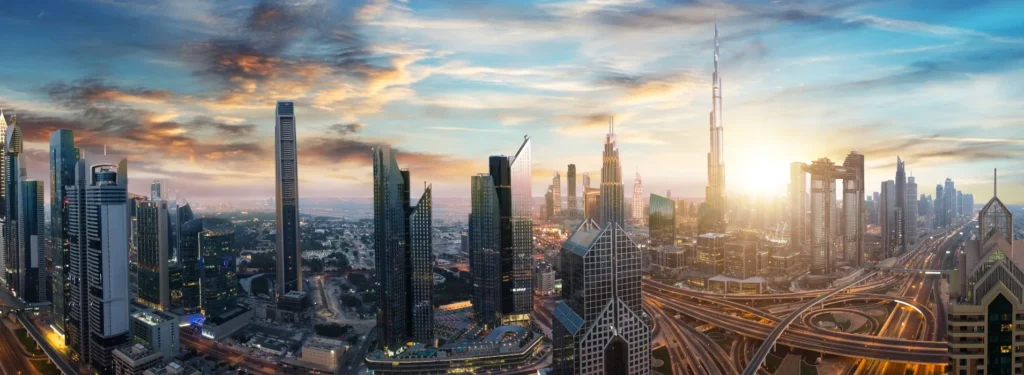
The afternoon delivers Dubai's other, newer identity in full force. The Dubai Mall is less a shopping center than a small city under one roof, and it sits at the foot of the Burj Khalifa, the tallest building on earth, its needle-thin spire visible from almost everywhere in the city. As evening falls you'll ride up to the observation deck, watching the desert flatten out beneath you into a grid of lights stretching to the Gulf, before descending to watch the Dubai Fountain perform below — jets of water choreographed to music and light against the building's base, a suitably spectacular close to a day built entirely around contrast, old trade against new ambition.
The final full day opens with a drive to Abu Dhabi, where the Sheikh Zayed Grand Mosque waits in white marble and gold, its courtyard inlaid with some of the largest floral marble patterns anywhere in the world and its main hall home to one of the largest hand-knotted carpets ever made. Nearby, the Louvre Abu Dhabi takes a different but complementary approach to grandeur — a museum housed beneath an enormous perforated dome that scatters sunlight across the galleries below like light through a desert canopy, its collection deliberately tracing shared threads across human civilizations rather than any single culture's story, a fitting echo of everything this trip has covered.
By late afternoon you'll return toward Dubai for one last adventure: a desert safari that trades the city's glass towers for open dunes one final time, bouncing across the sand by 4WD before a camel ride and a Bedouin-style camp dinner under the stars — a landscape and rhythm that will feel, after Wadi Rum, like a knowing farewell rather than a new introduction. Depending on flight timing, the evening closes with a late-night departure from Dubai, or an extension into a fifteenth day for those unwilling to let the trip end quite yet. Either way, three countries, three landscapes and two weeks of unhurried travel come to their natural close.
Clear on price, clear on value
Included
- 2 nights hotel in Egypt (5-star) with daily breakfast
- 4 nights Nile cruise, full board
- 1 night Amman + 2 nights Petra + 1 night Wadi Rum camp + 1 night Dead Sea
- 2 nights hotel in Dubai (5-star) with daily breakfast
- Every internal flight (Cairo↔Luxor, Aswan↔Cairo, Cairo↔Amman, Amman↔Dubai)
- All transfers in private A/C vehicles in every country
- Licensed local guides throughout Egypt, Jordan, UAE
- Every site entrance fee
- Desert safari + Wadi Rum camp full board
- Meals as specified
Not included
- International flights to Cairo, from Dubai
- Egypt visa ($25), Jordan visa (free with Jordan Pass or 40 JD), UAE is visa-free for most Western passports
- Optional Abu Simbel excursion
- Tips for guides, drivers, hotel and cruise staff
- Personal expenses, drinks
- Travel insurance
Choose your hotel tier
Same itinerary — pick a tier to see its hotels, cruise and prices. Switch anytime; the trip stays identical.
| Room | LowMay – Sep | HighOct – Apr |
|---|---|---|
| Doubleper person, sharing | $5,510 | Peak$6,500 |
| Singleper person | $7,600 | Peak$8,980 |
Per person, in US dollars. Not valid during Christmas & New Year (peak-date supplement applies). Hotel names are representative examples in the 4-star tier — your exact properties are confirmed for your dates.
| Room | LowMay – Sep | HighOct – Apr |
|---|---|---|
| Doubleper person, sharing | $8,040 | Peak$9,490 |
| Singleper person | $11,100 | Peak$13,100 |
Per person, in US dollars. Not valid during Christmas & New Year (peak-date supplement applies). Hotel names are representative examples in the 5-star tier — your exact properties are confirmed for your dates.
Cancellation, price & children
The terms that matter — worth a read before you send an inquiry.
Cancellation policy
Cancellation charges depend on how far before your arrival date you cancel, as a percentage of the total package price.
- 45+ days before arrivalDeposit only
- 30–44 days30%
- 15–29 days60%
- 7–14 days85%
- Under 7 days / no-show100%
Price policy
- Prices are per person, in US dollars, based on your hotel tier, occupancy and season.
- Internal Egypt flights are included; international flights and the entry visa are not.
- A 40% deposit confirms your hotels and services; the balance is due before travel — confirmed with your itinerary.
- Rates are subject to availability; peak-date supplements apply; the single supplement is as shown in the price table.
Children policy
- Infants under 2: free (no separate bed).
- Children 12+ are charged as adults.
- Child rates require sharing a room with two adults; a third bed or a child’s own room is quoted separately.
Package terms differ from a cruise-only booking (hotels + cruise + internal flights). Once domestic flights are ticketed they are non-refundable regardless of the tiers above. Final terms are confirmed in writing before any deposit is taken.
14 Days Egypt, Jordan & Dubai Grand Tour questions
Yes — it's the industry-standard split (7 Egypt + 4 Jordan + 3 Dubai). Anything less compromises one segment. If you have 16 days, add a Dead Sea rest day and one more Cairo day.
The Aswan → Amman leg on Day 7 involves a Cairo connection but is same-day and comfortable. Amman → Dubai on Day 12 is a single direct flight. Both flight days are built around one flight, not scattered.
Not recommended. Dubai's pace makes it hard to shift into Egypt's content-heavy first days. Egypt → Jordan → Dubai is the natural energy arc.
No — you're moving one direction (Egypt → Jordan → Dubai → home). Single-entry visas for each country work perfectly.
Just tell us. We'll use Day 7 morning for a slower Aswan disembarkation and an unhurried transit to Amman.
Ready for 14 Days Egypt, Jordan & Dubai Grand Tour?
Tell us your dates and we'll confirm availability and a clear price.